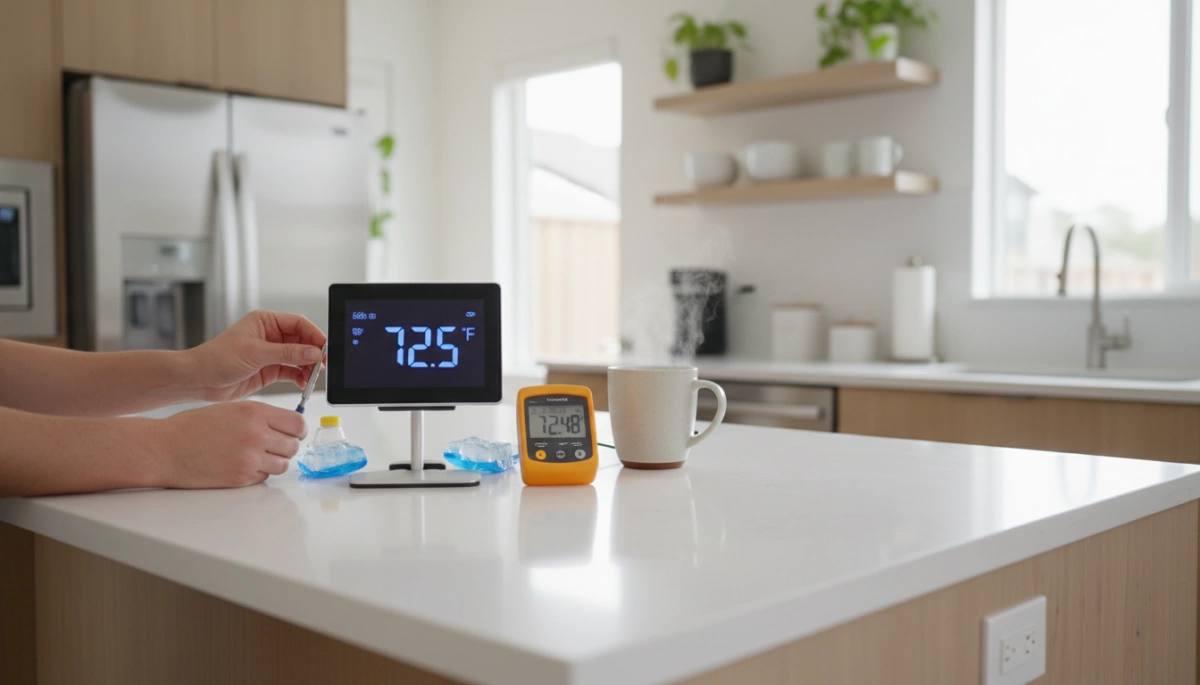
If you’ve ever found yourself second-guessing your cooking or brewing because your thermometer readings seem off, you’re not alone. Calibrating your thermometer without a fancy reference oven might sound tricky, but it’s actually easier than you think—and totally doable with everyday household items. Whether you’re aiming for perfect candy sugar stages, juicy grilled meats, or spot-on baking temperatures, mastering thermostat calibration without a reference oven will save you from costly kitchen disasters. Stick around, and I’ll show you simple, reliable ways to get your thermometer back on track—no expensive gear required!
Understanding Thermometer Calibration Basics
Calibrating your thermometer means checking how accurate it is and, if possible, adjusting it to give the right temperature. There’s a difference between checking accuracy (simply seeing if it reads correctly) and full adjustment (actually fixing the reading). At home, most of us focus on accuracy checks because full adjustments can be tricky without specialized tools.
Key Reference Points for Calibration
The most reliable benchmarks for DIY thermometer calibration are:
| Reference Point | Temperature (°F) | Temperature (°C) | Notes |
|---|---|---|---|
| Freezing point | 32°F | 0°C | Use ice bath method |
| Boiling point | 212°F | 100°C | Adjust for elevation if needed |
These points check if your thermometer reads correctly at the extremes of typical cooking ranges.
Factors Affecting Thermometer Readings
Several things can impact your thermometer’s accuracy:
- Elevation: Boiling point drops ~1°F for every 500 feet above sea level.
- Atmospheric pressure: Changes can slightly shift boiling temperature.
- Probe condition: Dirty or damaged probes give false readings.
- Thermometer type: Dial, digital, or candy thermometers vary in sensitivity.
Home Calibration Accuracy Limits
Keep in mind, DIY thermometer calibration methods usually achieve ±2–5°F accuracy. This is good for most kitchen needs but not as precise as professional lab calibration. Labs can achieve much tighter tolerances but require expensive equipment.
Quick Tip: Always check your cooking thermometer’s accuracy before important recipes. A few degrees off can mean the difference between perfectly cooked meals and kitchen disasters!
Essential Tools and Preparation
Before starting thermostat calibration without a reference oven, gather the right tools. Adjustable dial thermometers or digital models are best for calibration because they often allow fine-tuning. Avoid using cheap or non-adjustable thermometers if you want precise results.
For household items, you’ll need:
- Ice and cold water (for the ice bath method)
- A pot or container for boiling water
- An accurate room thermometer (optional, but helpful for cross-checking room temperature)
Safety is key when working with hot water. Handle boiling water carefully to avoid burns, and steer clear of using glass thermometers in boiling water unless the manufacturer specifies they can handle high temperatures.
Before calibration, clean your thermometer probe gently with warm soapy water and inspect it for any damage or dirt. A dirty or damaged probe can cause inaccurate readings. Preparing your tools well ensures your DIY thermometer accuracy tests are reliable and safe.
For more on handling temperature and ensuring appliance accuracy, see our guide on signs your refrigerator thermostat is failing.
Method 1: Ice Bath Calibration (Freezing Point Check)
The ice bath method is a simple, effective way to check your thermometer calibration at home using the well-known freezing point of water (32°F or 0°C). It’s especially useful for low-to-mid temperature thermometers, like meat or candy thermometers.
How to Create a Proper Ice Bath:
- Fill a container with crushed ice or ice cubes.
- Add clean, cold water until the ice is just covered—about a 1:1 ratio works best.
- Stir the mixture gently to get a consistent temperature throughout.
- Let it sit for a couple of minutes so the temperature stabilizes near freezing.
Testing and Adjusting Your Thermometer:
- Insert the thermometer probe or dial stem into the ice water without touching the container sides or bottom.
- Wait about 30 seconds for the reading to settle.
- Ideally, the thermometer should read 32°F (0°C).
- If your thermometer has an adjustment nut or dial, you can twist it to set the needle to 32°F while still in the ice bath.
- Digital models may require a manual offset adjustment, which you can note for future reference.
Common Errors to Avoid:
- Not using enough ice or allowing it to melt too much, which raises the water temperature.
- Letting the probe touch the container sides or bottom — this gives inaccurate readings.
- Rushing the reading before it stabilizes.
- Using tap water without ice, since it won’t be close to freezing.
This ice bath method provides a straightforward, reliable check for thermometer calibration at home, although expect about ±2°F accuracy, which is fine for most cooking uses. For a boost in accuracy, pairing this with a boiling water check offers a two-point reference you can trust better.
If you want tips on cleaning your thermometer probe before testing, check out this practical DIY guide to cleaning refrigerator parts — similar care helps keep your thermometer readings consistent.
Method 2: Boiling Water Calibration (Boiling Point Check)
Calibrating your thermometer using boiling water is a great way to check its accuracy, especially for higher-temperature cooking thermometers like meat or candy thermometers. Here’s a simple step-by-step guide to get it right at home, even without a professional reference oven.
Step-by-step Boiling Water Calibration
- Bring water to a rolling boil in a pot on your stove. Make sure the water is actively boiling—not just simmering—for best results.
- Check your elevation because the boiling point of water changes with altitude. For example, at sea level, water boils at 212°F (100°C), but it boils at lower temperatures at higher elevations. Use an elevation boiling point chart to find the exact boiling temperature for your location.
- Insert the thermometer probe into the boiling water. Avoid letting the probe touch the pot’s sides or bottom, as this can cause inaccurate readings.
- Wait for the reading to stabilize, which may take 30 seconds to a minute depending on your thermometer type.
- Note the reading and compare it against the expected boiling point at your elevation.
How to Adjust or Interpret Readings
- If your thermometer has an adjustable dial, use the calibration nut (usually under the dial) to set the needle to the exact boiling point.
- Digital thermometers can sometimes be reset or offset via button controls—check the manual.
- If your thermometer can’t be adjusted, simply note the difference. You can manually subtract or add this offset when measuring.
Tips for Accuracy and Stability
- Use a deep pot to allow the probe to be fully immersed without touching edges.
- Avoid rapid temperature changes or lifting the probe frequently, as this causes erratic readings.
- Make sure your water is pure (distilled water is best) because impurities can slightly change the boiling point.
- Conduct the test in a draft-free area to prevent heat loss affecting the temperature.
This boiling point adjustment method is particularly useful for thermometers used in frying, candy making, or grilling where precise high temps matter. For more detailed guidance on home appliance accuracy, you might find useful tips on when to consult professionals at applianceblog.info.
Using this method regularly helps maintain your thermometer’s reliability even without a fancy calibration oven.
Two-Point Calibration for Better Accuracy
For better thermometer calibration at home, combining the ice bath method thermometer check with a boiling water thermometer check gives you a two-point calibration. This approach helps identify if your thermometer’s readings are consistently off or if errors vary across the temperature range.
Start by checking your thermometer in a proper ice bath (0°C/32°F) and then in boiling water adjusted for your elevation using an elevation boiling point chart. Note the readings at both points. The difference between your readings and the expected temperatures reveals the offset or linearity error.
- Offset error means your thermometer consistently reads too high or too low by a fixed amount.
- Linearity error means the error changes between low and high temperatures.
You can calculate these errors by subtracting the true temperature from each reading, then decide:
- If the offset is consistent, apply a simple correction or adjust the dial if your model allows.
- If the error varies significantly, averaging the two offsets gives a rough correction, but note it’s less precise.
This two-point calibration gives a clearer picture of your device’s accuracy than using just one reference point, improving your thermometer’s reliability when cooking or candy-making. For more household tips related to temperature control and appliance care, you might find advice on how to clean robot vacuum brushes useful here.
Alternative Household Reference Methods
If you don’t have a reference oven for thermometer calibration, there are still some practical ways to check your thermometer’s accuracy at home. One easy approach is to cross-check your thermometer against multiple devices at room temperature, as most household thermometers should read close to the same ambient temperature. This gives a quick, rough idea of any glaring discrepancies.
You can also rely on known-temperature sources like your own body temperature (around 98.6°F / 37°C) or melting butter, which usually happens just below 95°F (35°C). These aren’t precise, but they offer useful checkpoints to see if your thermometer is way off.
For candy or sugar syrup thermometers, food-based tests are handy. For instance, knowing the temperature stages of sugar syrup—soft ball (235°F/112°C), hard crack (300°F/150°C), etc.—lets you compare your readings during cooking. This helps confirm if your candy thermometer calibration is within a reasonable range.
Another smart method is using a trusted secondary thermometer as a temporary reference if available. Just make sure this backup thermometer is known to be accurate. This setup allows you to compare readings side-by-side for checking offsets or inconsistencies before adjusting your primary thermometer.
These DIY thermometer accuracy checks can’t replace professional calibration but are handy for everyday kitchen use. For more detailed troubleshooting on temperature inaccuracies, you might find helpful tips in guides like fixing thermostat issues here.
What to Do If Your Thermometer Can’t Be Adjusted
Sometimes, your cooking thermometer may not have an adjustable dial or calibration screw, making it impossible to physically correct the reading. In these cases, applying a manual offset is a practical way to still get reliable results.
- Apply Manual Offsets: Note the difference between your thermometer’s reading and the known reference temperature (like an ice bath or boiling water). For example, if it reads 34°F in an ice bath instead of 32°F, subtract 2°F from every reading you take.
- Create a Correction Chart: Make a simple chart listing common temperature ranges you usually measure along with their adjusted values. This helps avoid mistakes when cooking or candy making.
- When to Replace the Thermometer: If the offset is large (more than ±5°F), inconsistent, or the thermometer responds slowly, it’s safer to replace it. Especially for critical tasks like meat thermometer accuracy, a reliable gauge is a must.
Applying offsets is a useful DIY thermometer accuracy hack, but remember: consistent calibration and a trustworthy device matter most. If you’re interested in prolonging your oven’s life alongside your thermometer’s performance, check out tips on how to revive your Lamona oven for smoother kitchen operations.
Common Mistakes and Troubleshooting
When calibrating your thermometer at home, watch out for some frequent pitfalls that can throw off your results. A poor ice bath—one without enough crushed ice or with excess water—won’t stabilize at freezing point, causing inaccurate readings. Similarly, water that’s boiling too vigorously may cause temperature fluctuations, making the boiling water thermometer check unreliable. Also, avoid parallax errors by always reading the dial or digital display straight on to prevent misreading the temperature.
Elevation and humidity can also impact your calibration. Higher altitudes lower the boiling point of water, so using an elevation boiling point chart is essential for correct adjustments. Humid or drafty environments can cool your thermometer probe unevenly, affecting accuracy during testing.
If you notice persistent discrepancies—even after repeating the ice bath and boiling point checks—your calibration may have failed. This often signals a damaged or worn probe, or a thermometer that can no longer hold a proper calibration. In such cases, applying manual offsets or considering a replacement might be necessary to maintain reliable readings. For more on troubleshooting cooling and temperature issues in household devices, check out this guide on troubleshooting noisy refrigerators.
When to Seek Professional Calibration or Replacement
If you rely on your thermometer for critical tasks—like lab work, commercial cooking, or any precise temperature control—DIY calibration methods won’t always cut it. Professional calibration ensures your thermometer meets strict accuracy standards and is especially important when small temperature errors can cause big problems.
For most home cooks or casual users, affordable, accurate thermometers can be a better option than repeated adjustments. Investing in a quality probe thermometer or digital model calibrated by the manufacturer can save time and give peace of mind.
If your current device consistently shows significant errors or can’t be properly adjusted, it’s usually wiser to replace it. Trying to work around large offsets by manual correction risks unreliable readings, which can impact food safety or experiment results.
For reliable advice on maintaining appliance parts and avoiding common issues that might affect thermometer accuracy, check out helpful guides like energy-saving maintenance tips that cover smart upkeep practices.



Leave a Reply