Most people assume a washing machine leak means the door seal is failing. It’s the first thing everyone checks — and usually the wrong diagnosis.
After nine years of owning a front-load washer, I can tell you that the drain pump filter and drain hose are responsible for more leaks and error codes than any other component. They’re also the most ignored parts in the machine. I neglected my filter for almost two years and ended up with an F21 error code on my Whirlpool Duet, a soaked laundry room floor, and a $180 service call that lasted 12 minutes. The technician unscrewed the pump filter, pulled out a compressed wad of lint, a hair tie, and most of a sock, and charged me for a full hour of labor. Never again.
What follows is what I actually do to keep water where it belongs.
Why Drain Filters Clog Faster Than Most People Realize
The drain pump filter sits at the bottom front of nearly every front-load washing machine — behind a kickplate or small access panel. Its job is to catch debris that escapes the drum before it reaches the pump impeller. The impeller is a spinning blade assembly; if a coin or sock fragment gets in there, the pump either jams or burns out. The filter prevents that. It does this silently and effectively until it’s packed solid and water has nowhere to go.
What the Filter Actually Catches
Lint is the obvious one. But the filter also traps pet hair, loose threads, paper tissue fragments, coins, small buttons, hair ties, bobby pins, and the occasional earring. A household running 8–10 loads per week accumulates enough material to noticeably restrict flow within 4–6 weeks. Add a dog that sheds heavily or a toddler whose clothing releases microfibers constantly, and you’re cleaning monthly at minimum.
Front-loaders from LG, Bosch, Samsung, and Whirlpool all depend on this filter doing its job. The Speed Queen TR7 top-loader, by contrast, uses an agitator design with a more open pump path that’s less susceptible to this kind of clogging — one of the few practical advantages of that older-style design.
How a Clogged Filter Actually Creates Leaks
A restricted filter creates back-pressure in the drain line. The pump motor works harder against that pressure, which does two things: it forces water to find alternative paths through connections that weren’t leaking before, and it can trigger thermal shutdown of the pump mid-cycle. When the pump shuts down mid-drain, standing water remains in the drum. That water sloshes against the door gasket in ways it wasn’t designed to handle. Sometimes it leaks outright. More often it just pools at the door seal and leaves everyone assuming the gasket is the problem.
There’s a second failure mode worth knowing. Increased pump pressure causes water to back up into the drum faster during spin transitions. Over time, this stresses the bellows seal and can cause hairline tears at the contact points — slow leaks that don’t show up until the machine is mid-cycle and the floor is already wet.
The Cleaning Schedule Nobody Puts on the Calendar
Bosch recommends filter cleaning every 3 months in the 500 Series WAT28401UC manual. LG recommends monthly for heavy use. My honest recommendation after years of trial and error: every 4–6 weeks for households of three or more people, every 2–3 months for one or two people with no pets.
Set a recurring phone reminder the same day you get the washer. This is a 10-minute task. The first service call it prevents will cost more than decades of those reminders.
How to Clean the Drain Pump Filter: A Practical Walkthrough
This process applies directly to the LG WM3900HWA, Samsung WF45R6100AW, Whirlpool WFW5000DW, and Bosch 500 Series — all front-loaders with an accessible pump filter behind a removable bottom panel. Top-load machines typically don’t have a user-accessible filter in the same location; check your manual before hunting for one that isn’t there.
Gather These Before You Open Anything
- A shallow baking tray or roasting pan — the filter cavity holds roughly 1–2 cups of residual water
- Several old towels placed directly under the access panel before you touch anything
- A small bottle brush or old toothbrush for scrubbing the filter mesh
- Needle-nose pliers — occasionally needed to grip a filter cap that won’t turn by hand after sitting for months
- A flashlight to inspect the cavity after removing the filter
The Step-by-Step Process
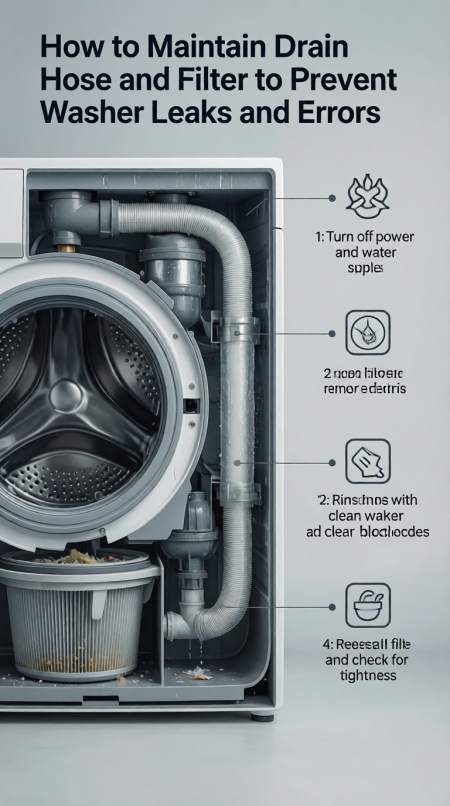
- Unplug the machine. Don’t skip this because the display is dark. Unplug it from the wall.
- Open the lower access panel — it either snaps open or has a single Phillips screw depending on the model.
- Find the small emergency drain hose coiled next to the filter cap. Pull it out, remove the rubber plug, and let it drain into your tray. This removes most of the standing water before you break the main seal. Skipping this step is exactly how people flood their laundry rooms.
- Once the emergency hose stops dripping, unscrew the filter cap counterclockwise. Go slowly — there’s almost always residual water behind it.
- Pull the filter straight out. Whatever’s coating it tells you something: heavy lint is normal wear, a black slick film means mold is growing in the drain path, and a sock fragment explains your last error code.
- Rinse the filter under hot running water and scrub the mesh with your brush. If there’s significant black biofilm, soak the filter in a 50/50 white vinegar and water solution for 10 minutes before scrubbing.
- Shine your flashlight into the filter housing cavity and remove any visible debris with the needle-nose pliers.
- Reinstall the filter hand-tight — snug but not cranked down — replace the emergency drain hose and its plug, and close the panel.
- Run a quick rinse cycle. Stand there and watch the access panel for drips before you walk away.
Realistic time: 10–15 minutes the first attempt. After two or three cleanings, you’ll finish in under 10.
The Drain Hose Mistakes That Cause Most Installation Leaks
The drain hose is responsible for more unexplained leaks than almost any other component, and the vast majority trace back to installation errors — not defective hoses.
The most widespread mistake: inserting the hose too far into the standpipe. Whirlpool, LG, and Samsung all specify a maximum insertion depth of 4.5 inches (about 11 cm). Go deeper and you create a siphon effect — the machine drains, water gets siphoned back into the tub, then the machine tries to drain again. You’ll see this as extended cycle times, recurring drain errors, or a tub that never seems to fully empty between cycles.
The second error: kinking the hose when pushing the machine back against the wall. The hose exits the rear at a downward angle, and if there isn’t at least 4–6 inches of clearance between the back of the machine and the wall, the hose bends sharply right where you can’t see it. This is the single most common cause of OE errors on LG front-loaders. Pull the machine all the way out and trace the hose before you assume the pump is failing.
Standpipe Height: The Spec That Matters
The drain hose outlet needs to terminate between 24 and 96 inches above the floor — that’s the spec from all major manufacturers. Lower than 24 inches and siphoning is nearly inevitable without an air gap device installed. Higher than 96 inches and the pump fights gravity for the entire drain cycle, shortening its service life measurably over years of use. Most residential standpipes fall within this range naturally, but if you’re draining into a laundry tub, use a plastic hose guide to hook the hose over the rim — don’t let it rest at the bottom of the tub.
Checking Hose Clamps Annually
The pump-side hose connection uses either a spring clamp (factory original on most machines) or a screw clamp. Spring clamps weaken after 5–7 years of vibration. If the clamp moves even slightly when you squeeze it with pliers, replace it. A Fernco 5/8-inch stainless screw clamp costs under $2 at any hardware store and outperforms the original spring clamp on any machine past the five-year mark. This takes 90 seconds once you have the machine pulled out — do it every time you clean behind it.
Error Codes That Point Directly to Drain Problems
What does F21 mean on a Whirlpool washer?
F21 means the drain cycle exceeded 8 minutes and the control board gave up waiting. The cause is almost always a clogged pump filter, a kinked drain hose, or debris wrapped around the pump impeller. Clean the filter first. If F21 returns after cleaning, trace the hose for kinks. If it still comes back, the pump impeller likely has a cloth item tangled around it — clearing that requires removing the pump, which is a 45-minute DIY job on the WFW5000DW with a quarter-inch nut driver and a Torx T-20 bit.
What does 5C mean on a Samsung washer?
5C (displayed as SC on older Samsung models) is the drain error on machines like the WF45T6000AW and WF45R6100AW. The pump filter sits behind the lower-right kickplate. Drain the emergency hose into a tray first, then remove and clean the filter. If 5C persists with a clean filter and a clear hose, check the standpipe — a partially blocked standpipe is the most frequently missed cause of recurring 5C errors, especially in older homes with cast iron drain plumbing.
What does OE mean on an LG washer?
OE stands for Outlet Error — LG’s designation for a failed drain cycle on models like the WM3500CW and WM3900HWA. Follow the same sequence: filter first, then hose, then standpipe height. LG machines are specifically prone to hose pinching because the outlet is positioned low and close to the rear panel, leaving minimal margin when the machine sits against drywall. If OE keeps returning after filter cleaning, pull the machine out completely and inspect the full hose run before calling a technician.
Tools and Supplies Worth Keeping On Hand
| Item | Use Case | Approximate Cost | Verdict |
|---|---|---|---|
| OXO Good Grips Flexible Bottle Brush | Scrubbing filter mesh and reaching inside the housing cavity | $10–12 | Buy it — the flexible shaft reaches inside the filter cavity without disassembling anything extra |
| Affresh Washer Cleaner (W10501250) | Monthly drum and drain line maintenance | $10 for 6 tablets | Worth every penny — one tablet monthly in an empty hot cycle prevents the biofilm buildup that restricts flow and causes that mildewy smell |
| Camco 00073 Drain Hose Extension | Extending hose reach without sagging or kinking | $15–18 | Situational — only necessary when your standpipe is more than 5 feet from the machine’s outlet |
| Fluidmaster Full Hose Replacement Kit | Replacing cracked or aging drain hose | $22–28 | Choose this over a generic hose — the included clamps are correct diameter and the hose wall resists kinking |
| Stainless screw hose clamp, 5/8 inch | Replacing the weakened factory spring clamp at the pump connection | Under $2 | Keep two in your tool drawer at all times — this is a $2 fix for what becomes a $150 repair if ignored |
| Oatey Washing Machine Drain Pan (34067) | Catching filter blowback and containing long-term leak damage | $25–35 | Yes if you’re on an upper floor — the Oatey 34067 has a threaded drain port that connects to a floor drain for active drainage |
The Affresh W10501250 tablets are the only recurring purchase I’d call non-negotiable. One tablet per month in an empty hot cycle keeps the internal drain path clean and dramatically reduces the slimy biofilm that causes flow restriction and odor. Everything else on that list is situational or one-time.
When It’s Time to Replace, Not Clean
If you’ve cleaned the filter, confirmed the hose runs clear with no kinks, verified correct standpipe height, and the error code or leak keeps returning within a few cycles — the pump itself is failing. The Whirlpool W11032770 and Samsung DC31-00054A drain pumps run $65–110 in parts and are 45-minute DIY replacements on most front-loaders; on a machine under five years old, that repair makes sense, but on anything over eight years old already showing multiple symptoms, price out a replacement machine first.
Clean the filter every 4–6 weeks — that single habit eliminates the majority of front-load washer service calls before they ever happen.