Navimow i110N vs i206 AWD: Which Wire-Free Robot Lawn Mower Wins?
By Joseph Seeger · 2026-02-03
Two Navimow models that share the wire-free DNA but split on coverage and slope. Picking the right one is a 60-second decision once you know your yard.
If you have spent any time researching wire-free robotic lawn mowers, you have probably narrowed your shortlist to two Navimow models that look almost identical on a comparison page: the i110N and the i206 AWD. Same brand, same wire-free promise, same RTK-plus-Vision navigation. So which one belongs in your yard?
The honest answer depends on two numbers you already know about your property: how steep is the steepest section, and how big is the total mowing area.
Quick Verdict
✅ VerdictPick the Navimow i110N if your yard is closer to 1/4 acre with moderate slopes (under ~30%). Better coverage-per-dollar ratio.
Pick the Navimow i206 AWD if your yard tops out around 0.15 acre but has serious slopes (up to 45%). Slope tolerance over coverage.
The first filter is the simplest: how many square feet do you actually need to mow each week?
If you have not measured, here is a fast way: open Google Maps satellite view, drop pins on your lawn corners, and use any free area calculator. Subtract obvious non-grass areas (driveway, patio, garden beds). The number you get is your real cut area, which is usually 30-50% smaller than what people guess by eye.
Under 6,500 sq ft: either model fits. Pick on slope.
6,500 to 10,890 sq ft: i110N is the right choice unless slopes force the i206 AWD.
Over 10,890 sq ft: both Navimow models are undersized.
⚡ Quick TipIf your yard sits in the middle band and is mostly flat, the i110N wins on coverage-per-dollar even though the sticker price is slightly higher than the i206 AWD – $929 for 10,890 sq ft versus $899 for 6,534 sq ft works out to $0.085 vs $0.138 per sq ft.
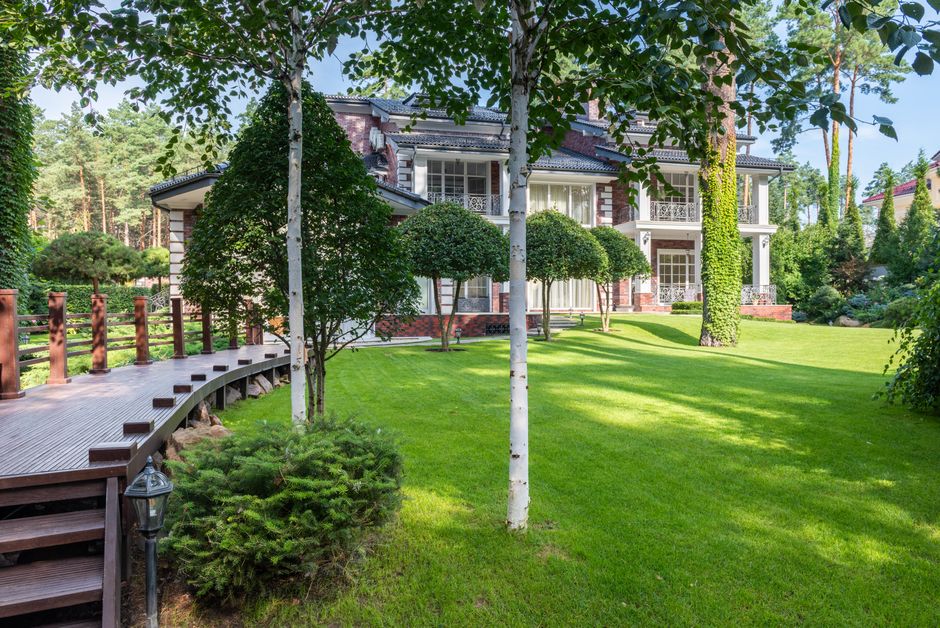
A typical 1/4 acre suburban yard – the upper edge of where Navimow i110N comfortably operates.
Then the Slope Question
Here is where the two models genuinely separate. Slope is the single most common failure mode for “wire-free” robotic mowers because manufacturers love the headline coverage spec but bury the slope number.
The i110N uses a 2WD layout, which is the industry default. It handles typical suburban slopes fine. What it struggles with is the wet morning cut on a 35% incline where the rear powered wheels lose grip and the front caster lifts.
The i206 AWD adds active drive to all wheels, which keeps torque on the ground even when the chassis tilts. The published 45% slope rating is well past anything most homeowners face, but the practical implication is that the mower handles 30-35% slopes without slipping, slowing down, or veering off course.
💡 Worth KnowingIf you have ever watched a robotic mower spin its wheels and call out for help on a hill, you understand why the AWD upgrade matters. If your steepest section is under 25%, AWD is overkill.
Positioning: EFLS NRTK vs Standard RTK
Both models layer GNSS positioning with camera-based vision so the unit can hold its pattern when one signal source briefly drops. The difference is in the GNSS layer:
i110N – RTK + Vision: standard real-time kinematic positioning with vision backup.
i206 AWD – EFLS NRTK + Vision: EFLS (Exact Fusion Locating System) tuned to a network RTK reference, which removes the need for any base station hardware. Slightly more resilient to brief signal loss.
In practice, both work. The EFLS NRTK setup is slightly more forgiving in fringe conditions (heavy tree canopy, brief building shadow, mixed sky), but neither system is a “set it once and forget the network” arrangement.
Setup and Day-One Experience
The setup story is the same on both models: install the Navimow app, charge the mower, walk the boundary in mapping mode, add no-go zones, and schedule cycles. There is no buried boundary cable on either unit.
One subtle difference: the i206 AWD ships with a Garage S shelter (separately shipped). The i110N does not bundle one by default. The Garage S extends the working life of wheels, sensors, and dock contacts. If you go with the i110N and your dock site is exposed, factor a third-party shelter into your budget.
Battery Life and Cycle Behavior
The i206 AWD trades some battery economy for slope capability. Driving four wheels uses more energy than driving two, which is part of why the coverage cap is 0.15 acre per cycle.
i110N: usually handles a 1/4 acre yard in a single cycle.
i206 AWD: typically two cycles per week on its rated 0.15 acre, more on sloped sections.
Steep sections that defeat 2WD robotic mowers – exactly where the i206 AWD earns its premium.
Pricing Reality
At list, the two models are within $30 of each other. That makes the choice cleaner than it looks because price is essentially a wash. You are picking between more square feet (i110N) or more slope (i206 AWD), not paying a meaningful premium for either.
That is rare in this segment. Most wire-free upgrades come with a $400-$600 step up.
Bottom Line
Two strong options, narrowly differentiated:
i110N: better coverage value, fine for moderate slopes, no built-in shelter.
Affiliate disclosure: this article contains affiliate links to Amazon. We may earn a commission on qualifying purchases at no additional cost to you. Recommendation is driven by yard requirements, not commission structure.